Showing posts with label English Heritage. Show all posts

13 April, 2021

The “Turf“ Wall; Science Denial at English Heritage / Historic England – Now It’s Official

To test the water, and offer English Heritage a chance to consider the matter I sent an e-mail explaining the Science that proves Bede, writing in the C8th was wrong to suggest Hadrian built a Wall of turf aka The Turf Wall.

Twenty years ago their own excavation Appleby produced unequivocal evidence that this section of Wall was made of Timber, information they failed to comprehend at the time.[1]

The science is simple and irrefutable.

1. Soil science.
If turf is blocks of local soil held together with plant roots, then the composition of the "Turf " Wall deposit at Appletree with its complete absence of mechanical particles other than some sand grains in what is essentially a peaty deposit indicates that this cannot have derived from a local soil and therefore, can not ever been made of Turves.
[QED] [2]

2. Palynology
The palynology dominated by tree species alder, oak and in particular Hazel, [ a shrub] [3]
3. Palaeobotany
The recovered plant macrofossils were dominated by pieces of carbonised wood, trunk & branch up 0.01m, and notable remains of Ceratodon purpureus fruiting bodies. [4]

Conclusions.

4. All the scientific evidence, indicate the use of timber to construct this rampart, a conclusion which is also confirmed by the Roman’s own accounts of their engineering.[5]
5. It is fair to conclude that the concept of a “Turf Wall” is a native literary tradition, now largely driven by nominative determinism, and the momentum of the inherited orthodoxy in institutions.

I sent an email outlining the arguments using their data [6]

Hi

I am a structural archaeologist working in the NE of England and I have serious concerns about the denial of Science in favour of faith-based arguments.

20 years ago you produced a report that proved beyond all doubt that the Romans did not build a "Turf" Wall using soil science palynology and palaeobotany; tragically, the report concluded the exact opposite.

This prompts serious questions about quality control and competence at the highest level.

Thus, my principle question is who takes responsibility for such serious mistakes and the blatant denial of science that ideas like a "Turf Wall" represent?

Is anyone at EH prepared to defend this non-scientific stance in public or discuss the issues it raises?

Best

Geoff Carter

After the usual robotic exchange of pleasantries, they responded thusly.

Dear Geoff,

Thank you for your email. It is always interesting to hear alternative interpretations. However, it remains our view based on the evidence recovered from a number of excavations and associated analyses that the wall is constructed of turves in the widest sense with Appletree as the classic example.

A consideration of turves in the archaeological record is laid out in Hall, A R 2003 Recognition and Characterisation of Turves in Archaeological Occupation Deposits by means of Macrofossil Plant Remains. Historic England Research Report 16/2003.

Kind regards,

Rosie Ryder

Historic England Communications Team

I responded, seeking reassurance they had understood the argument, and further pressing my point, but no further communication was forthcoming.[8]

" . the wall is constructed of turves in the widest sense with Appletree . . " is basically a denial of the science, with not enough wiggle room to escape such a charge. 

Observations.

  • While as an academic subject, “Research“ is driven by simple reproduction of the existing narrative, since the skills necessary to understand archaeological base-data are often lacking.
  • The reference cited reviews the evidence of “turf” in a variety of contexts, and demonstrated that archaeological expectations are not by and large confirmed by paleoenvironmental data
  • It highlights a broader lack of basic methodology and the tendency to use of excavations as an opportunity to reinforce or fine tune part of an existing narrative, ignoring or excluding data that does not fit the expected pattern.
  • However, even learning Archaeology out of a book from someone who learned it out of a book, should not preclude a basic understanding of soil science, it is after all, what archaeologists find most of.
  • Institutions, working in monopoly, offering careers for life, and in an environment where their customers, students and the public can be assumed to be wrong, have no market pressures to raise their game above a minimalistic mediocracy.
  • Archaeology is not mission critical, nobody dies through this sort of science denial, and while disappointing, it’s only our money and their institutional creditability that is being wasting.


Notes 

[1] Hadrian’s Wall Archaeological Research by English Heritage 1976–2000

edited by Tony Wilmott
http://archaeologydataservice.ac.uk/archiveDS/archiveDownload?t=arch-1416-1/dissemination/pdf/9781848021587_all.pdf [Accessed 25/12/2014],

[2] op. cit.116 The plant macrofossils,  Allan Hall

[3]op cit p. 114 the pollen  James Wells

[4]Ceratodon purpureus, Fire Moss,  present in quantity, which as the name suggests is an early coloniser after forest fires, and it commonly grows on is dead wood.

[5] a. C. Julius Caesar, Gallic War 
http://www.perseus.tufts.edu/hopper/text?doc=Perseus:text:1999.02.0001  [Accessed 25/12/2014],
b. C. Julius Caesar, Commentaries on the Civil War  William Duncan, Ed.
http://www.perseus.tufts.edu/hopper/text?doc=Perseus:text:1999.02.0076 [Accessed 25/12/2014],
c.  The Military Institutions of the Romans (De Re Militari) by Flavius Vegetius Renatus, Translated from the Latin by Lieutenant John Clarke, translation published in 1767.   Etext version by Mads Brevik (2001)
http://www.digitalattic.org/home/war/vegetius/  [Accessed 25/12/2014],
d. Polybius, Histories http://www.perseus.tufts.edu/hopper/text?doc=Perseus:text:1999.01.0234 [Accessed 25/12/2014],[7] 12 Feb, 09:51
[6] Dear Rosie,
Thank you for your prompt reply and the link; this is a very important paper as it it demonstrates my view that the “evidence” is not scientific, but is driven by archaeologists’ expectations.  
It confirms that from the plant micro-fossil point of view the case is not proven in any Roman context, and draws attentions to other, more normal processes that can account for these assemblages.  [The occasional use of turf as a roofing material and even for small walls in area devoid of other resources is not in dispute].
Deposits derived from crop processing, organic flooring such as reeds, charcoal burning,
and the decay of building materials such as daub are theoretical sources of plant assemblages, that might be similar to turves.
The issue of soil science, in particular the lack of mineral particles in “Peaty” deposits is not discussed; it is one of the deeper issues with archaeological fieldwork being driven by the existing literature.  
I have observed that archaeologists when dealing with soil have a culture of “stick in a bag and ask the specialists what it means”.   To which the hard-pressed specialist has asked for a specific question about a specific context.  The science is being asked the wrong questions; rather than, where did the turves come from?
It should be what is the origin of this deposit?
It is partly a tradition of the way archaeology funding is granted in terms of objectives, project design and “Answering Questions”.
In short, there is nothing in the evidence presented that demonstrates the use of turf in Roman Military contexts, and I would argue that the plant micro-fossil evidence that has been retrieved confirms the use of timber.
Further, the soils at Appletree make it impossible; that is not an opinion, it is archaeological soil science 101.*
I will look at the data tables in more detail, particularly the mosses, but you do not have any “Science” on your side, only a literary tradition dating back to Bede.
Naturally, it is a matter I intend to push you on, can you take this matter any further?
Best
Geoff
* Being an archaeologist is much more difficult than people imagine, especially if you have actually been trained as an archaeological lecturer by an a university lecturer with no real experience of being an archaeologist or writing up complex excavations.
Geoff Carter
Structural Archaeologist

05 February, 2021

Top 10 Peer reviewed Myths about Hadrian's Wall

Hadrian's Wall sits on the boundary of Archaeology and History, apart from its scant remains, it exists as a literary and artistic creation, it is already something imagined, a myth.  It is thus, an individual conception, part of the visual conditioning of a pictorial past and subject to cognitive dissonance when this imaginary world is challenged.

Literacy is the key divide, the dead weight of Latin, a the slim volume of Historical data, and the need to justify knowledge of both, has distorted archaeological dataset along the Proto-historical interface.

At this important boundary we are also confronted with our own barbaric tribal ancestors; half naked heathens, primitive peoples, framed by colonialism, classism and xenophobia.

This invisible world has been made real through a visual culture with its own district history, however, just how this imagined past has interacted with the literary narrative, and it’s effect on the interpretation of the archaeological evidence is more difficult to assess.  As result, and in order to keep the list down to just ten, the wide range of visual myths is not examined, but it is worth noting the deficiency in the representation of timber as an engineering material; why apparent buildings like Turrets and Milecastles are imagined without roofs is baffling.

It is also important to remember that Archaeology is traditionally taught as an “Arts” subject, and is not evidence based, being driven by reproduction of existing texts by academics, often without an understanding of underlying datasets. While as a subject, archaeology does not directly effect human well-being and society, it’s an expensive indulgence among a select group of academics, which as we shall see, incorporates much science denial and irreconcilable non sequiturs at its core.

This clearly a very subjective list, and based on my highly contentious view that academic archaeology should be evidence based, sadly a view not shared by the institutions and stakeholders that insist on promulgating and merchandising these myths.

Top 10 myths.

1. The post pits on the berm were Cippi pits

One of the traps other countries have not fallen into is Cippi pits, a fantastic conflation of two different Latin references to explain away double post-pits which are evidence of a Roman timber rampart. A good example of Tyne and Wear Museums Archaeology’s interpretation of archaeology features through Latin text, and the incidental creation of a new species of spiky tree.

2. The Berm was for structural stability

Traditionally, the space between the Ditch and later Wall was regarded as required for “structural stability”, but if you pushed the Wall over it still would not fall into the ditch; it is not an argument that an engineer, ancient or modern would concede as valid.

3. The Wall was successful cohesive proactive project

While the archaeological evidence has not been well understood, it has typically been framed by a mindset of Roman superiority and achievement, [that discounts native culture and abilities], seeing the apparent changes in design as proactive driven by “decisions”. The archaeological evidence suggests that the project was driven and ultimately derailed by external factors, particularly native resistance on both sides of the Wall.

4. The Wall was for trade, display or distraction

The nonchalant approach to the construction, coupled with the apparent lack of a consistent strategy, [as in No. 3 above], has led some commentators to assume or suggest that the Wall was not driven by military necessitates, but was primarily for the regulation of trade, show, or even something to keep the army busy.

5. The 80 Man Century

Idiosyncratically, the one issue that might have seemed fairly clear from the Latin, the number of men in a Century, has taken on a life of own. The origin may lie in the use of the 8 man leather tent, forgetting the concept of men being on guard and being required to look after the units collective kit as part of the baggage. I am happy to concede 80 men formal fighting units because of the need for support troops and important specialists, but a Century ideally comprised 100 men, [otherwise Decimation becomes the killing of 1 in 8, etc.].


6. Cavalry Barracks and forces

There is a tenancy to impose ideas about the size and nature of cavalry units onto the archaeology with no regard to the real practicalities of equine care and accommodation. As a result horses have been envisaged packed like sardines into infantry barracks and even milecastles, contrary to all established practices and norms of this well documented type of building.

7. Manning levels

In a sense we are touching on the visual representation of the Wall as a continuous manned barrier, however, even at its most optimistic, the overall manning levels of about a century per mile which precludes any realistic defence of the Curtain Wall. The strategic objective of any attacker would have been the capture of a gate.

8. Wallsend Horse Toilets

This has to be the dumbest most tin hat piece of madness on the Wall to date, and a tribute to Tyne & Wear Museums Archaeology complete disregard to reality, science and the concept of evidence. In reality, this is a regular barrack block with a set of stairs marked by a slot and posthole in each unit, and I find it difficult to conceive by what mental process this archaeological feature came to be interpreted a “Horse toilet” on the basis of no supporting evidence. In the real world horses are kept on bedding which absorbs the urine and is regularly changed to prevent harmful ammonia making the horse ill.


Three horses are packed incongruously into a small room with a wooden floor with proper no manger or water supply, which is accessed by a door to narrow safely accommodate a horse.

9. The Valium was a boundary

This is probably the largest "earthwork" in Europe and popularly misrepresented as a "Bank & Ditch"; if that were the case there would be no issue with it also being deemed some sort of boundary. The Engineering clearly indicates that this was foundation trench for a frontier road that was never completed, no other explanation can realistic account for its physical form and the massive investment in man hours.

10. The Wall was built of Turf


The idea of structures constructed from turf dates back to statements made by Bede in the 8th century, dutifully reproduced by generations of historians, and confirmed by early attempts at archaeology. Twenty years ago, an English Heritage produced the evidence that confirmed beyond all reasonable doubt that this was not the case, tragically, in a remarkable piece of science denial, the report reached the opposite conclusion.

This is probably the most portentous misconception in Roman military archaeology, since any structure not made of stone is presumed to have been constructed of turf, rather than timber as all the archaeological evidence and even the classical sources would indicate.

Conclusions

Clearly, a lot “peer review” in archaeology signifies little more than that the author works in or for an institution with peers. However, given the importance of this archaeology to the local economy, and both national and international scholarship it is little short of a scandal that an idiosyncratic narrative, based on tradition and myth is being sold to students and the public.

The dumbing down of the subject, even at postgraduate level, to little more than copying out text books in your best handwriting, has ensured that the skill set necessary to understand archaeological evidence has not developed, and is perhaps illustrative of a wider decline in British educational standards driven the need for profitability.

It is worth noting that it is not just our eccentric local Museums and bottom feeding Universities that sell these narratives, but also English Heritage, The National Trust and the “Elite” Russell branded institutions like Oxford & Cambridge.

Caveat Emptor.

18 January, 2021

UK Academic Archaeology; Incompetence, Science Denial and Racism

The good news is that my cancer has not returned, but having reached the "Do Not Revive" age group, I am not taking anything for granted, and I  have further surgery scheduled in the next few weeks.  

So I intend to spend what time remains to me in trying to prevent young people, international students  and tax payers being stiffed by these unscrupulous institutions peddling science denial.

I have decided to return to blogging and hopefully more making videos featuring some of the more outrageously dumb tin hat archaeology being promulgated at public expense. 

Obviously, Academics with a job for life in a monopoly where the customers always wrong have no need to defend their ignorance, any more than English Heritage or Museums services feel the need to justify their science denying stance. 

I have to admit I have found it psychologically difficult to reconcile being blackballed for challenging science deniers; apart from the money, why are these people [1] so anxious to piss in our collective chips?

Denial or Ignorance

We all should be aware of the dangers of science denial, but to allow it blossom in Higher Education is either stupidly criminal or criminally stupid, but despite repeated requests, Newcastle University refuse to confirm which is the case for their former Post-Graduate Dean and his staff. [op. cit.]

One might be forgiven for thinking that archaeology was not a real academic subject but a form of badly informed infotainment, after all, celebrities and members of the public don't do forensic accounting or midwifery on the weekend, but are regularly invited to hack holes in inoffensive ancient monuments for out amusement.

Sadly it's not just bottom feeders of Russell branded universities like Newcastle, but also those who regard themselves as serious institutions like Oxford and Cambridge that are guilty of dumbing down the subject through science denial and/or ignorance.

For the hoard of begowned over paid functionaries,  deans, chancellors and the like who see their task as improving the return of the Universities' property portfolio archaeology is an obvious target for dumbing down; do this to a science at you would be risking lives and our economic future.  

Fundamentally, merit is gained in subjects like archaeology by copying out other peoples work in your best handwriting, regardless of its merit or evidential basis, allowing for the reproduction of myths, fallacies and ensuring the progress of the credulous.

You are taught "archaeology" out of a book from some one who learned it out of a book, so all the victims of the system can do is practice archaeology out of a book. Thus,  "Methodology" in archaeology is basically what proper subjects call  "bias".


Many archaeology students naively imagine they are learning to be an archaeologist, but unfortunately they are being trained by a lecturer to be a lecturer, their fees are subsiding the very small percentage sufficiently compliant students to become the next generation of lecturers.

I am reliably informed that Academics teaching archaeology are payed the same money as those engaged in evidence based teaching, so ignorance is not only bliss it's just as financially rewarding as real knowledge.

A Classical Gaff

Being taught archaeology out of book by someone who learned it out of book would not be a problem if archaeologist found books, but surprisingly what they actually find is soil, and that's where the problems start.

Every institution involved with Roman Britain,  universities, museums, and most notably English Heritage persist in the promoting the myth of the Romans building things out of "turf".

This myth dates back to the eight century and Venerable Bede, and has been faithfully reproduced in their best handwriting by generations of academics.

Tragically, twenty years ago English Heritage excavated the "Turf Wall", and having gathered all the scientific data to demonstrate beyond all reasonable doubt that this was not true, concluded it was made of "turf".  [2]

The power of nominative determinism is quite extraordinary, as is the fact that, in denial of the peer reviewed evidence,  academics continued to buy into this myth and sell it to their students.

The Roman Wall was no more made out of turf than the Moon is made from cheese, anyone regardless of status or salary, who tells you otherwise is either ignorant of, or in denial of basic soil science.

However, that's just the pointy end of a very long stick;  it is common practice to assume that any Roman structure not made of stone must therefor made of "Turf", [Q.E.D.] [!], resulting in numerous "turf" forts and a second "Turf" wall in Scotland - none of which has a scintilla of evidence to support it. 

Experimental archaeology - racism in action.

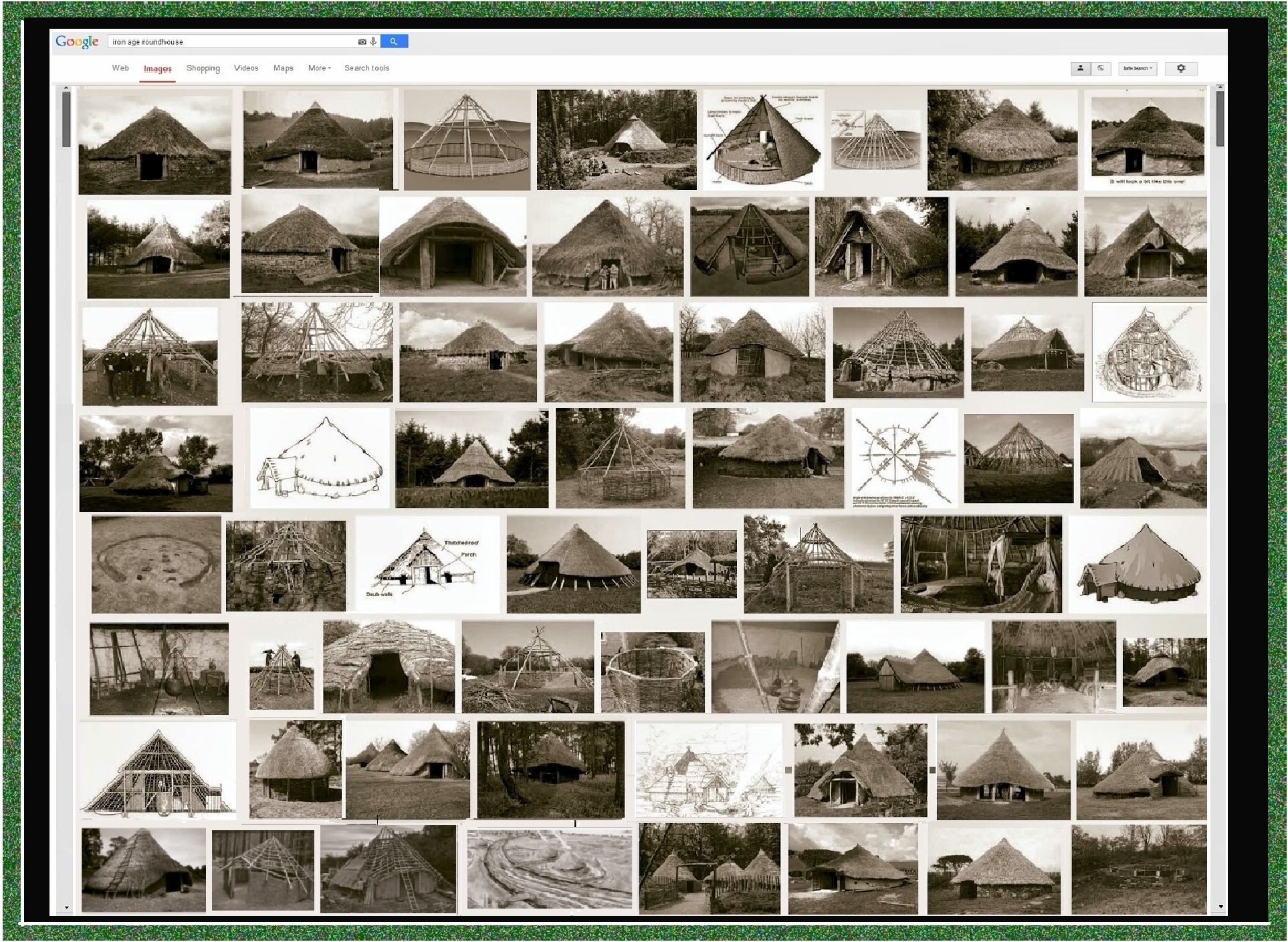
"Experimental" Archaeology tells you a great deal about Academics and virtually nothing about the past.  Repeated attempts to reproduce "primitive" "African" mud huts in the UK in defiance of the archaeological evidence is a tribute to the persistence of ideas about Cultural Evolution.  These concepts, similar to those which fuelled the genocidal politics of National Socialism, and are a remarkable example of both the racism and science denial that is central to UK academic archaeology.  

Portrayal of our ancestors as some form of white negro is a perfect analogue of racial theory that drove British imperialism and the slave trade; this is theme I intend to pursue in future work. It is also evident from our shared our visual culture of the past, which having no evidential basis serves only to illuminate the racist presumptions of UK academic culture. 

Personally, I feel it important to try to preserve some of the intellectual culture that made our education some of the best in the world, but once you dumb it down I suspect that it's gone for good.

However, I intend to keep on going because in some countries, particularly in the USA and parts of Europe, archaeology is still treated as a serious academic subject and has not fallen victim to the cadre of mediocre racist science deniers who have infiltrated our education system. 


Notes.

[1] I refer explicitly in this case to Professor Niell Marshall - Former Post-graduate dean and enabler of Dr Jane Wester a self confessed "expert in Iron Age Building Cosmology".

While "Cosmology" is a big word [Neill],  so is "tautology" and it's criminal that you and your colleagues can't grasp such basic evidential principles, and cannot recognise or admit you are defrauding your students by faith based teaching. 

I retain a special affection for Professor Ian Haynes ["I wish I could help you Geoff, but I don't want to stabbed in the back by the people who stabbed, - I have my career to think about"], for his complicity in this duplicity.

[2] Wilmott, T., [ed]. 2009. Hadrian's Wall: Archaeological Research by English Heritage .(NB. p. 114 the pollen James Wells p. 116 The plant macrofossils, Allan Hall, )